High throughput proteomics is becoming increasing popular as a technique to profile the proteome of biological samples.
This course looks at the theory of proteomics, the processing of raw mass spectra into quantitative values, and some options for the analysis of quantitative proteomics data to identify differentially abundant proteins.
Pre-Course Requirements & Suggestions
Whilst not required, it may be useful to attend the following courses to supplement the knowledge you'll get from this one.
Course Content
Principles of Proteomics Mass Spectrometry
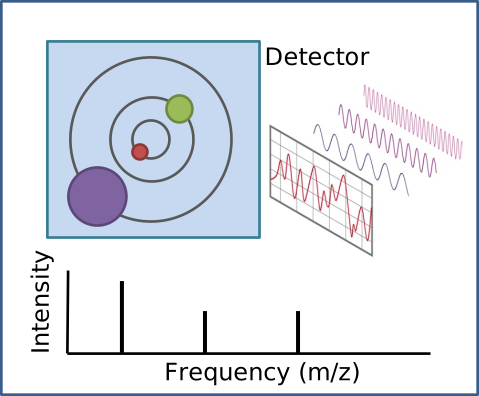
We start by looking at how mass spectrometers are able to measure the composition of a mixture of proteins. We discuss the standard workflow for bottom-up proteomics and the different types of proteomics inluding DIA and DDA.
Identifying proteins from spectra
We go through the theory of how mass spectra can be searched against databases to identify and quantify the peptides in a sample. We discuss issues of contamination, mis-identification and how to deal with drop-outs. We talk about the use of TMT for sample multiplexing.
Public Proteomics Datasets
We look at the publicly available datasets for proteomics in the proteomics repositories and the different types of file they contain.
Running a database search
We go through the process of setting up and running a simple database search from raw proteomics files using the maxquant program.
Loading proteomics data into R
We look at the various R frameworks for the analysis of proteomics data and the variety of input files you may encounter. We load in some data and look at the various metrics which you will encounter.
Initial data assessment and quality control
After loading the data we look at some of the common metrics to assess the overall breadth and quality of data within the dataset.
Data Visualisation and Quantitation
Once we are happy with the quality of our data we can start to explore the biological question for our experiment. We use various types of data visualisation to understand what's happening in our samples. We look at data normalisation and imputation of missing values.
Statistical Analysis
We finish by looking at the statistical analysis options for a simple two-condition experiment. We look at both generic quantitative stats as well as packages which try to offer more tailored solutions for proteomics. We also see some options for plotting quantitative and statistical results.